Iterative Inverse
This example presents a method for inverting the forward ADRT which
takes a different approach to the inverse implemented in
adrt.iadrt(). The inverse here uses an iterative solver, in
particular SciPy’s scipy.sparse.linalg.cg() routine that
implements the Conjugate Gradient (CG) method[1] but
another implementation could be used instead, if desired.
The operation defined by adrt.adrt() is linear. If we consider
its matrix \(A\), then the operation adrt.bdrt() defines its
transpose \(A^T\). Using these, we invert the ADRT applying the
conjugate gradient method to the normal equations:
\(A^{T}Ax=A^{T}b\).
Here we use SciPy’s implementation in particular, provided in
scipy.sparse.linalg.cg(). To do this we define
ADRTNormalOperator an instance of
scipy.sparse.linalg.LinearOperator for the operation
\(A^{T}A\) and then use this in a function iadrt_cg which
performs the actual inversion operation using conjugate gradients.
import numpy as np
from scipy.sparse.linalg import LinearOperator, cg
import adrt


class ADRTNormalOperator(LinearOperator):
    def __init__(self, img_size, dtype=None):
        super().__init__(dtype=dtype, shape=(img_size**2, img_size**2))
        self._img_size = img_size

    def _matmat(self, x):
        # Use batch dimensions to handle columns of matrix x
        n_batch = x.shape[-1]
        batch_img = np.moveaxis(x, -1, 0).reshape(
            (n_batch, self._img_size, self._img_size)
        )
        ret = adrt.utils.truncate(adrt.bdrt(adrt.adrt(batch_img))).mean(axis=1)
        return np.moveaxis(ret, 0, -1).reshape((self._img_size**2, n_batch))

    def _adjoint(self):
        return self


def iadrt_cg(b, /, *, op_cls=ADRTNormalOperator, **kwargs):
    if b.ndim > 3:
        raise ValueError("batch dimension not supported for iadrt_cg")
    img_size = b.shape[-1]
    linop = op_cls(img_size=img_size, dtype=b.dtype)
    tb = adrt.utils.truncate(adrt.bdrt(b)).mean(axis=0).ravel()
    x, info = cg(linop, tb, **kwargs)
    if info != 0:
        raise ValueError(f"convergence failed (cg status {info})")
    return x.reshape((img_size, img_size))
We’ll use the same starting image as in the Quickstart, but we
will apply a small amount of normal noise to its ADRT to illustrate
the difference in behavior between the iterative inverse here and
adrt.iadrt().
# Generate input image
n = 16
xs = np.linspace(-1, 1, n)
x, y = np.meshgrid(xs, xs)
img = 0.5 * ((np.abs(x - 0.25) + np.abs(y)) < 0.7).astype(np.float32)
img[:, 3] = 1
img[1, :] = 1

# Compute ADRT and add noise
img_plain_adrt = adrt.adrt(img)
noise_mask = np.random.default_rng(seed=0).normal(scale=1e-4, size=img_plain_adrt.shape)
img_noise_adrt = img_plain_adrt + noise_mask

# Plot noisy ADRT
vmin = np.min(img_noise_adrt)
vmax = np.max(img_noise_adrt)
fig, axs = plt.subplots(1, 4, sharey=True)
for i, ax in enumerate(axs.ravel()):
    im_plot = ax.imshow(img_noise_adrt[i], vmin=vmin, vmax=vmax)
fig.tight_layout()
fig.colorbar(im_plot, ax=axs, orientation="horizontal", pad=0.1);
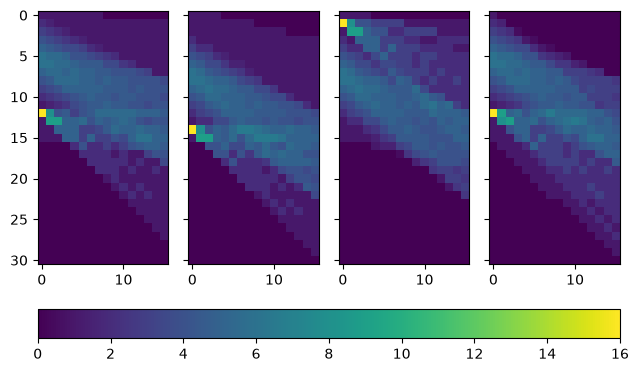
If you compare this against the ADRT in Quickstart, you should see that the differences are visually imperceptible. However, the two inverses produce very different results.
iadrt_inv = adrt.utils.truncate(adrt.iadrt(img_noise_adrt)).mean(axis=0)
cg_inv = iadrt_cg(img_noise_adrt)

fig, axs = plt.subplots(1, 3, sharey=True)
plot_elements = [(img, "Original"), (cg_inv, "CG Inverse"), (iadrt_inv, "iadrt Inverse")]
for ax, (data, title) in zip(axs.ravel(), plot_elements):
    im_plot = ax.imshow(data)
    fig.colorbar(im_plot, ax=ax, orientation="horizontal", pad=0.08)
    ax.set_title(title)
fig.tight_layout();
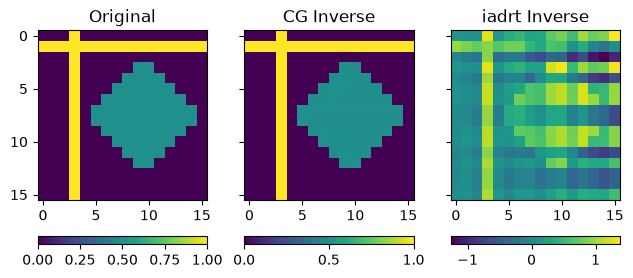
The inverse provided by adrt.iadrt() is an exact inverse to the
forward ADRT, but it is very sensitive to noise in its input. It is
therefore not suitable for cases where the forward ADRT was not
exactly applied, or where noise may be present. In such cases, a
different approach such as the iadrt_cg illustrated here may be
more suitable.
Multiple Noise Levels
We repeat the above demonstration of the iadrt_cg iterative inverse
for several noise levels. For each example a new noise mask is drawn
from a normal distribution \(\mathcal{N}(0, \sigma I)\).
rng = np.random.default_rng(seed=0)
fig, axs = plt.subplots(2, 2, sharey=True)
fig.suptitle("CG Inverses at Several Noise Levels")
for scale, ax in zip([1e-2, 1e-1, 1, 10], axs.ravel()):
    noise = rng.normal(scale=scale, size=img_plain_adrt.shape)
    cg_inv = iadrt_cg(img_plain_adrt + noise)
    im_plot = ax.imshow(cg_inv)
    fig.colorbar(im_plot, ax=ax)
    ax.set_title(rf"$\sigma = {scale}$")
fig.tight_layout();
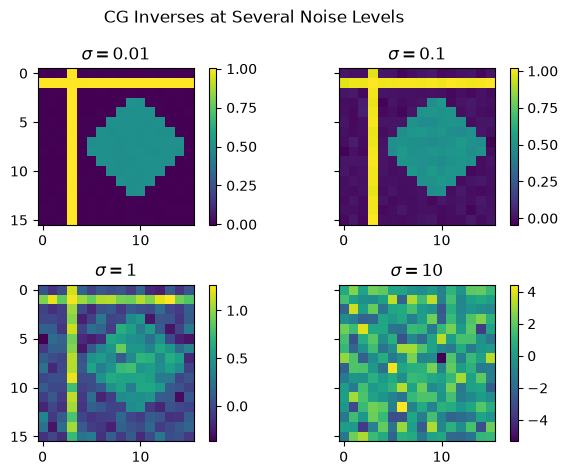
The results produced by iadrt_cg remain relatively clean even at
noise with scales much larger than those used for the comparison with
adrt.iadrt(). While exact, adrt.iadrt(), is unstable and
so an iterative approach such as the one demonstrated here may be
advantageous for certain applications and can be assembled with the
help of routines in this package.